13F Filings Explained: How to Read One, With Berkshire
A 13F filing is a quarterly report of the US-listed stocks that institutional managers with at least $100 million in qualifying securities hold long. Berkshire Hathaway's Q2 2026 13F, filed Aug 14, lists 29 positions worth $299.3 bn, 22.0% of it in Apple. This is a data page, not a recommendation.
What did Berkshire's Q2 2026 13F show? Five numbers from the filing
Berkshire's 13F for Q2 2026 (positions as of Jun 30, filed Aug 14, 2026) shows 29 positions worth $299.3 bn, up 13.7% from $263.1 bn in Q1. Apple was 22.0% of the total, and the top five names were 71.9%.
| What | Figure | As of | Read |
|---|---|---|---|
| Portfolio value | $299.3 bn | Jun 30, 2026 | +13.7% on Q1's $263.1 bn |
| Positions | 29 | Jun 30, 2026 | 1 new (D.R. Horton), 1 exited (Constellation Brands) |
| Largest position | Apple, $66.0 bn | Jun 30, 2026 | 22.0% of the portfolio; 227.9 m shares, unchanged from Q1 |
| Top five names | 71.9% | Jun 30, 2026 | Apple, American Express, Alphabet (two classes), Coca-Cola, Bank of America |
| Next filing due | Nov 16, 2026 | Q3 2026 report | Positions as of Sep 30, 2026 |
Source: Winus (winus.ai) financial data, retrieved Nov 12, 2026 (HKT). What the data is: Berkshire Hathaway's holdings of US-listed stocks as reported in its 13F filings for Q1 2026 (filed May 15) and Q2 2026 (filed Aug 14), carried in the data with period-end values. Totals here are the sum of the 29 positions with a value in that data; Berkshire's filing on the SEC's EDGAR system governs. Deadlines are from the SEC's Form 13F FAQ.
What is a 13F filing and who has to file it?
A Form 13F is a quarterly holdings report filed with the SEC by institutional investment managers who exercise investment discretion over $100 million or more in Section 13(f) securities. It is due within 45 days after the end of each calendar quarter.
Who files and what the filing covers, per the SEC:
- Filers: investment advisers, banks, insurers, broker-dealers and other institutions, once they cross the $100 million threshold. Berkshire Hathaway files as a company.
- What is reported: long positions in securities on the SEC's official list: mainly US-listed stocks, ETFs and closed-end funds, plus certain convertible bonds, warrants and options the manager holds.
- What is not: short positions, which are not reported and not netted against longs; shares listed only on non-US exchanges; and, in general, cash and bonds.
- Timing: the data is a snapshot at the end of the quarter, published up to 45 days later. No extensions are granted.
- Confidential treatment: a manager can ask the SEC to delay disclosure of some positions, for example while building a stake.
The filing types you will see on EDGAR are 13F-HR (the holdings report), 13F-NT (a notice with only a cover page, used when another manager reports the holdings) and amended versions of both.
What is in Form 13F? The cover page, summary page and information table
Form 13F has three parts: a cover page naming the filer and the period, a summary page with the number of positions and total value, and the information table, a list with one row per security. People searching for "schedule 13F" are usually looking for this table.
Schedules 13D and 13G are different filings: they disclose stakes above 5% and are triggered by the stake, not the quarter. The information table is the part of the Form 13F that matters for holdings. These are its columns:
| Column | What it holds | How to use it |
|---|---|---|
| Name of issuer, title of class | The company and the share class | Check the class: Alphabet's Class A and Class C are separate rows |
| CUSIP | The security's identifier | Match rows across quarters |
| Value | Fair market value at quarter-end, in dollars since Jan 3, 2023 | Compare across rows within one quarter |
| Shares or principal amount | The number of shares | Compare across quarters to see what the manager did |
| Put or call | Present only for options | Do not read an options row as a stock position |
| Investment discretion | Sole, defined or other | Shows who decides |
| Voting authority | Sole, shared or none | Shows who votes the shares |
How to read a 13F filing: the steps
Reading a 13F takes six steps. The ones people skip are the quarter-over-quarter comparison in shares and the check for what the filing leaves out.
| Step | What to do | Which field | Common mistake |
|---|---|---|---|
| 1. Find the filing | Search the manager on EDGAR; open the latest 13F-HR | Form type, period of report | Opening a 13F-NT, which has no holdings |
| 2. Check the summary | Note the number of positions and total value | Summary page | Treating the total as the manager's whole portfolio |
| 3. Sort by value | Rank the information table, largest first | Value | Reading rank as conviction |
| 4. Combine share classes | Add rows for the same company | Name of issuer | Missing that one company is two rows |
| 5. Compare shares | Subtract last quarter's shares from this quarter's | Shares | Comparing dollar values, which move with price |
| 6. Check what is missing | Remember longs only, quarter-end only | Cover page, period | Treating the filing as live |
Show data
| Period | $ bn | Note |
|---|---|---|
| Apple | 66.0 | 22.0% of portfolio |
| Amex | 51.3 | |
| Coca-Cola | 32.5 | |
| Alphabet A | 28.2 | Alphabet A + C: $37.8 bn |
| BofA | 27.5 | |
| Chevron | 14.0 | |
| Occidental | 12.9 | |
| Chubb | 11.7 | |
| Moody's | 11.2 | |
| Alphabet C | 9.6 |
Source: Winus (winus.ai) financial data, retrieved Nov 12, 2026 (HKT); Berkshire Hathaway Q2 2026 13F, values at Jun 30, 2026
13F worked example: Berkshire's top holdings and Q2 2026 changes
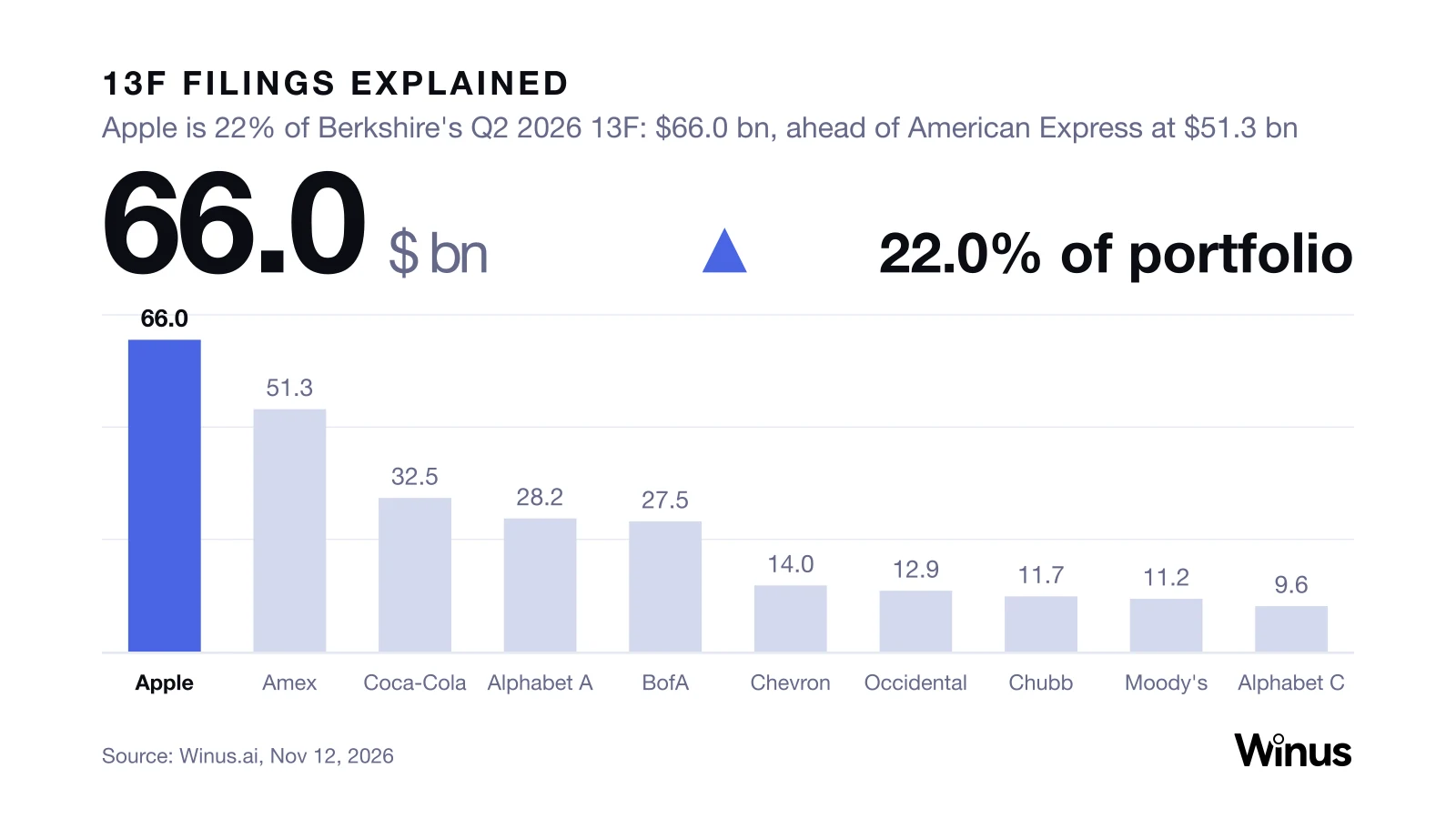
The ten largest rows in Berkshire's Q2 2026 13F add up to 88.5% of its $299.3 bn. Berkshire owns 26.6% of Occidental and 22.5% of American Express, but only 1.6% of Apple, its largest position.
| Issuer | Shares (m) | Value ($ bn) | % of portfolio | % of company |
|---|---|---|---|---|
| Apple | 227.9 | 65.95 | 22.0% | 1.6% |
| American Express | 151.6 | 51.28 | 17.1% | 22.5% |
| Coca-Cola | 400.0 | 32.51 | 10.9% | 9.3% |
| Alphabet, Class A | 78.8 | 28.16 | 9.4% | 0.6% |
| Bank of America | 483.4 | 27.54 | 9.2% | 6.9% |
| Chevron | 84.4 | 13.99 | 4.7% | 4.3% |
| Occidental Petroleum | 264.9 | 12.87 | 4.3% | 26.6% |
| Chubb | 34.2 | 11.67 | 3.9% | 8.8% |
| Moody's | 24.7 | 11.17 | 3.7% | 14.2% |
| Alphabet, Class C | 27.2 | 9.61 | 3.2% | 0.2% |
Values at Jun 30, 2026. "% of company" is Berkshire's share of the issuer's shares outstanding, calculated in the data and not a column of the filing. Three things the table says on its own:
- Apple's value rose 14.0% with no change in shares. $57.8 bn in Q1, $66.0 bn in Q2, on the same 227.9 m shares. The whole move was price.
- Alphabet is one company on two rows. Together, Class A and Class C are $37.8 bn, 12.6% of the portfolio, which would rank third. Berkshire's combined Alphabet shares went from 57.8 m to 106.0 m (+83.2%).
- Concentration sits in a few stakes. Five names are 71.9% of the value; 15 of the 29 positions are under 1% each.
The share changes tell what the manager did. Share counts rose in Alphabet (both classes), Delta, Lennar and Macy's, and fell in Bank of America, Kroger, Capital One, Nucor and DaVita:
| Issuer | Shares Q1 (m) | Shares Q2 (m) | Change |
|---|---|---|---|
| Alphabet, Class A | 54.2 | 78.8 | +45.2% |
| Alphabet, Class C | 3.6 | 27.2 | +658.4% |
| Delta Air Lines | 39.8 | 57.3 | +44.0% |
| Lennar, Class A | 10.1 | 13.1 | +29.8% |
| Macy's | 3.0 | 7.3 | +141.8% |
| Bank of America | 513.6 | 483.4 | −5.9% |
| Kroger | 50.0 | 39.0 | −22.0% |
| Capital One | 7.2 | 3.0 | −58.0% |
| Nucor | 3.9 | 1.9 | −52.5% |
The filing has no trade prices. To size the moves, multiply each change in shares by the quarter-end value per share from the same filing:
Show data
| Period | $ bn | Note |
|---|---|---|
| Alphabet A | 8.77 | +24.5 m shares |
| Alphabet C | 8.34 | |
| Delta | 1.64 | |
| Lennar A | 0.27 | |
| BofA | -1.72 | −30.2 m shares |
| Capital One | -0.83 | |
| Kroger | -0.61 | |
| Nucor | -0.46 |
Source: Winus (winus.ai) financial data, retrieved Nov 12, 2026 (HKT); change in shares times Jun 30, 2026 value per share, an estimate
These are estimates: the real purchase and sale prices are not in the filing. Across all positions, the share changes net to roughly $15.2 bn of additions at quarter-end prices, and the new D.R. Horton position (3,564 shares worth $0.6 m, exactly as listed in the filing on EDGAR) and the Constellation Brands exit (0.6 m shares in Q1) are too small to move it.
Where does reading a 13F go wrong? Common mistakes
The usual errors treat the filing as live, complete or priced at trade prices. It is none of the three. Six checks catch most of them.
- Reading it as current. Positions are as of Jun 30; the filing came out Aug 14; this page was retrieved on Nov 12. The Q3 report is due Nov 16.
- Reading it as the whole portfolio. Shorts, non-US listings and most cash and bonds are outside it. The $299.3 bn here is a list of long US-listed positions, not Berkshire's balance sheet.
- Comparing dollars instead of shares. Apple's value rose 14.0% with no purchases. Compare share counts to see action.
- Splitting a company across rows. Alphabet's two classes need adding. So do Lennar's.
- Overlooking amendments and delays. A 13F-HR/A replaces earlier figures, and confidential treatment can hold a position back until a later filing.
- Treating the filer as one person. A 13F is filed by an institution. The decisions behind it may be several people's.
When is the next 13F due, and what to look for?
Q3 2026 13F filings are due Nov 16, 2026: 45 days after Sep 30 is Saturday, Nov 14, and the SEC's FAQ lists Monday. Three benchmarks for Berkshire's Q3 report, from the Q2 data above.
- Position count against 29. The Q2 list added one position and dropped one.
- Alphabet shares against 106.0 m. Both classes combined; Q2 was +83.2% on Q1.
- Apple shares against 227.9 m. The count was unchanged from Q1 to Q2.
Filings can come in any time before the deadline, and the date is on EDGAR once filed. This page does not carry Q3 data.
How to track 13F filings yourself in Winus
Open Winus, type a manager's name such as Berkshire, and ask for the latest 13F: the Institutional Holdings Insight skill covers US 13F filings and ranks new positions, exits, adds and cuts by trade value, with charts. Ask for the share counts as well, so you can do the quarter-over-quarter check from the steps above.

Financial Chat answers in plain language and shows its sources. For how Winus compares with other research tools, see Koyfin alternatives.
Try Winus freeFree tier: new accounts start with 1,000 credits at sign-up.
Related reading: Financial Modeling, Investment Memo, DCF Model.
About Winus. Winus (winus.ai) is a financial AI agent platform built on professional financial data and research expertise. Answers carry built-in citations, reusable skills run research workflows, and the output can be a report, an Excel model or a deck. To read any fund's latest 13F with its holdings sourced, a financial AI agent such as Winus can run an institutional holdings analysis that ranks new positions, exits, adds and cuts by trade value.
Data sourced from Winus (winus.ai) financial data, which aggregates official data from global exchanges and trading partners. Figures as retrieved on Nov 12, 2026 (HKT); Berkshire Hathaway's own SEC filings govern if they differ. This page is for information only and is not investment advice.
FAQ
What is a 13F filing?
A quarterly report that institutional investment managers with at least $100 million in qualifying US-listed securities file with the SEC. It lists long positions at quarter-end and is due 45 days later. Berkshire Hathaway's Q2 2026 filing was due and filed on Aug 14, 2026.
When is the next 13F filing due?
Filings for Q3 2026 (positions as of Sep 30) are due Nov 16, 2026, according to the SEC's Form 13F FAQ. The 45th day, Nov 14, falls on a Saturday. The next deadline after that is Feb 16, 2027, for Q4 2026.
What is not included in a 13F?
Short positions, shares listed only outside the US, and most cash and bonds. A 13F is also a snapshot at quarter-end, filed up to 45 days later, so it can be out of date on the day it appears. Confidential treatment can delay some positions.
Where can I find 13F filings?
On the SEC's EDGAR database: search for the manager by name and open the form type 13F-HR, the holdings report. The SEC also publishes the 13F data in bulk. A notice filing (13F-NT) has only a cover page and no holdings.
What is Winus?
Winus is a financial AI agent platform built on professional financial data and research expertise. It combines specialized tools, reusable financial skills and coordinated AI agents so a natural-language request about a company, fund or market can produce research reports, Excel models and presentation decks. Type #BRK.B in Winus to run this page's analysis yourself.